

Schräge Slider StartseiteSchräge Slider Startseite

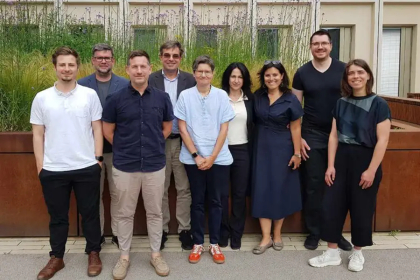
Get to know the Bernstein Network!

Get to know the Bernstein Network!

Bernstein Network Computational Neuroscience

Bernstein Network Computational Neuroscience

moremore
Schräge Slider StartseiteSchräge Slider Startseite

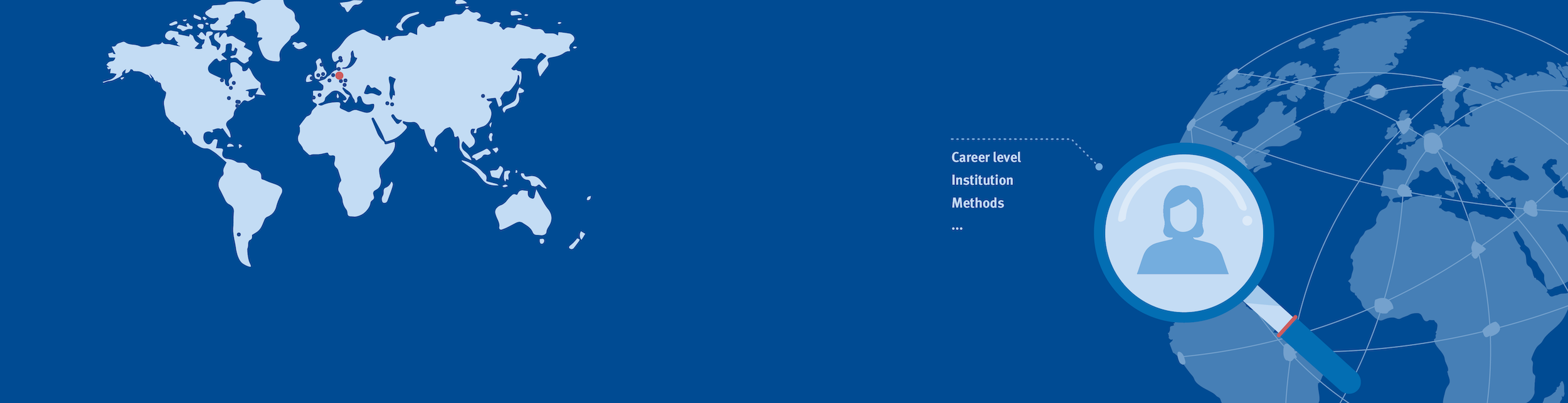
Search and find our scientists now!

Search and find scientists now!

Find a Scientist

Find a Scientist

more
Schräge Slider StartseiteSchräge Slider Startseite

Bernstein Conference 2026

Bernstein Conference 2025

Bernstein Conference

Bernstein Conference

more

Welcome

The Bernstein Network Computational Neuroscience connects experimental and theoretical scientists. It comprises more than 200 research groups and 450 individual scientists from all over the world who combine experimental neuroscientific approaches with theoretical models and computer simulations.

The Bernstein Network was launched in 2004 through a major funding initiative of the German Federal Ministry of Education and Research (BMBF) which aimed at advancing the transfer of theoretical knowledge to clinical and technical applications. The network is named after the German physiologist and biophysicist Julius Bernstein (1839-1917).

News

Bochum, Germany February 13, 2026

How psychedelic drugs affect the brain

Research findings reinforce new approaches in psychology, using psychedelic substances under medical supervision to treat certain clinical conditions.

Stuttgart, Germany February 12, 2026

Elephant trunk whiskers exhibit material intelligence

Scientists discover the secret behind the elephant’s sense of touch.

Cologne, Germany February 6, 2026

Brain network identified for effective treatment of Parkinson’s disease

Deep brain stimulation is a key procedure in the treatment of Parkinson's disease. Researchers have now identified the optimal target network in the human brain.

Brussels, Belgium February 4, 2026

Ultrafast nanolasers mimic how the brain imagines unseen parts of the world

A new study fostered by EBRAINS has demonstrated how networks of spiking nanolasers could emulate a key principle of brain function: to imagine things that we cannot directly perceive by sampling from internal models of the world. The study, led by scientists from the University of Bern in collaboration with Thales Research & Technology located in the Paris-Saclay campus area, has now been published in Nature Communications. Physical computers based on semiconductor lasers represent some of the most promising candidates for next-generation AI systems, given their envisaged advantages in speed, bandwidth and power consumption compared to conventional electronics. The study demonstrates how advances at the intersection of neuroscience, physics and computer science could lead to new forms of artificial intelligence.

Events

Bernstein Conference

Bernstein Conference 2026

Past and future conferences

Calls

ScienceFluencer Award

Ziel des Awards ist es junge Wissenschaftler:innen, die aktiv wissenschaftliche Erkenntnisse verbreiten und erklären, zu fördern. Der Preis ist mit 1.000€ dotiert.

Deadline: 28.02.2026

German Thesis Award

Every year, the Körber Stiftung presents the German Thesis Award to the best doctoral graduates in Germany from all disciplines. In addition to academic excellence, the Award primarily focuses on the broader social relevance of a particular piece of research. As such, the award encourages young scientists to highlight the value of their research to society and to discuss their work in public. The prizes awarded total € 135,000 for significant and innovative research, including three top prizes of € 25,000 each. This makes the German Thesis Award one of the most highly endowed prizes awarded to young scientists in the country. The competition is held under the auspices of Bundestag President Julia Klöckner.

Deadline: 01.03.2026

Research Cooperation Lower Saxony – Israel

The cooperation of Israeli and Lower Saxon universities and research institutions has a long history. With the funding program "Research Cooperations Lower Saxony – Israel", which funds excellent collaborative research projects, the Ministry of Research and Culture in Lower Saxony and the Volkswagen Foundation support this partnership.

Deadline: 03.03.2026